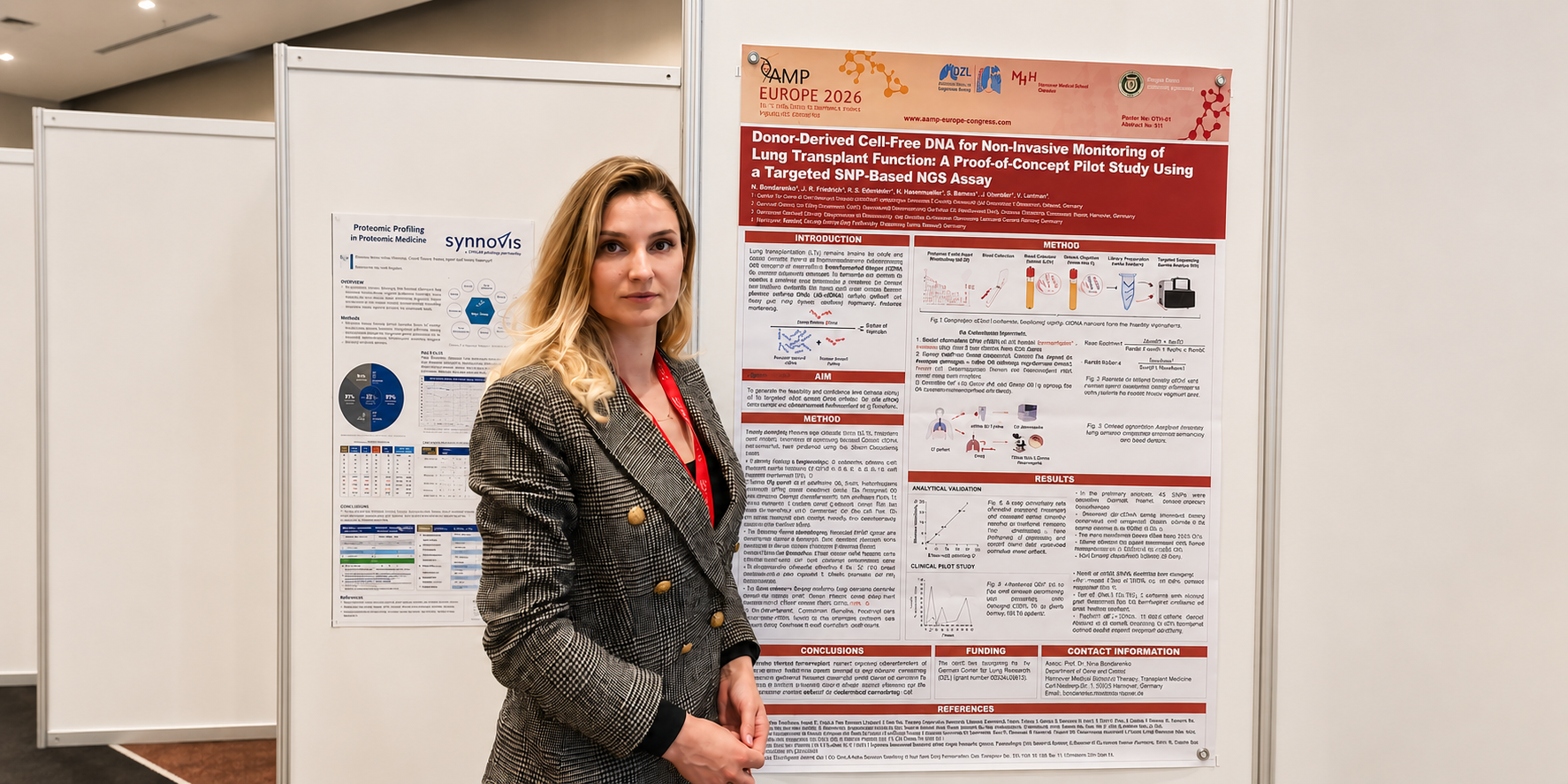
At this year’s Annual Meeting of the German Center for Lung Research (DZL), outstanding scientific work was once again recognized with poster awards. In a short series, we are presenting the award-winning projects involving researchers from the DZL site BREATH. Today’s feature focuses on Carina Alexandra Pawlow from Hannover Medical School. The PhD student received the poster award in the category “Pulmonary Hypertension” for her research into the immune landscape of healthy and severely diseased lung tissue.
Carina Alexandra Pawlow conducts her research at the Institute of Transplant Immunology at Hannover Medical School in the research group of Prof. Dr. Christine Falk. Together with her colleagues, she investigates how the composition and spatial distribution of immune cells change in end-stage lung diseases, with a particular focus on pulmonary hypertension (PH).
Although inflammatory and immune processes are increasingly being linked to severe lung diseases, it is still not fully understood which immune cells are present in diseased tissue and what role they play in disease progression. In pulmonary hypertension in particular, interactions between the immune system and pathologically altered blood vessels may be of relevance.
Investigating immune cells directly in lung tissue
For the study, the researchers analyzed lung tissue and mediastinal lymph nodes from patients with pulmonary hypertension, COPD and interstitial lung diseases and compared them with control tissue.
The methods used included flow cytometry as well as single-cell and spatial transcriptomics. In particular, the Xenium approach makes it possible not only to characterize immune cells at the molecular level, but also to determine their location within the lung tissue.
A particular focus is placed on so-called tissue-resident memory T cells, or TRM T cells. These memory T cells remain permanently within the tissue and can contribute both to local immune defense and to chronic inflammatory processes.
Disease-specific immune landscapes
The results obtained so far reveal clear differences between healthy and severely diseased lung tissue as well as between the different disease entities. In pulmonary hypertension, monocytes, macrophages and granulocytes were particularly abundant, whereas lymphocytes predominated in COPD. Disease-specific changes were also observed in NK cells and cytotoxic CD8⁺ TRM T cells.
The spatial organization of the immune cells is particularly interesting. In lung tissue from patients with PH, the researchers found clusters of TRM T cells and NK cells in close proximity to altered blood vessels and bronchi. In healthy tissue, by contrast, these cells were more diffusely distributed. Activated lymphoid follicles were also more frequently observed in the lymph nodes of patients with PH.
A possible role of the immune system in pulmonary hypertension
The findings suggest that specific immune cell populations may also play a role in diseases that are not primarily considered immune-mediated. In pulmonary hypertension, the data indicate that the interaction between immune cells and pathologically remodeled blood vessels could be particularly relevant.
“I am very pleased to receive this award and that our work has received such positive feedback,” says Carina Alexandra Pawlow. “In the next steps, we would particularly like to investigate the different TRM T-cell subtypes and their spatial distribution in greater detail in order to better understand their potential role in pulmonary hypertension.”
We wish Ms. Pawlow every success with her future research, look forward to following and supporting her further scientific career and hope to see her at next year´s DZL Annual Meeting.

BREATH doctoral researcher Carina Alexandra Pawlow with her award-winning poster at the DZL Annual Meeting. (Photo: private)