New perspectives for the treatment of fibrotic lung diseases: In the international research project BREATH-EC, scientists led by Hannover Medical School (MHH) are developing a novel cell-based therapeutic approach aimed at halting the progression of pulmonary fibrosis and potentially even reversing existing tissue damage. The European Union is funding the four-year collaborative project with approximately €10 million. Several researchers from the DZL site BREATH are playing key roles in the project.
Pulmonary fibrosis is characterized by progressive remodeling of lung tissue, with excessive formation and deposition of connective tissue and a gradual decline in lung function. Despite significant advances in the development of antifibrotic therapies, treatment options remain limited. Currently available medications can slow disease progression, but regeneration of already fibrotic lung tissue is generally not possible.
This is where the new EU-funded collaborative project BREATH-EC comes in. Coordinated by Prof. Dr. Nico Lachmann from the Department of Pediatric Pulmonology, Allergology and Neonatology at MHH, the international research consortium is pursuing an innovative immune cell-based therapeutic approach. The aim is to genetically engineer macrophages to recognize early fibrotic changes in lung tissue and specifically target the underlying disease processes.
Genetically Engineered Macrophages as a Therapeutic Approach for Pulmonary Fibrosis
Macrophages play a central role in regulating inflammatory processes, maintaining tissue homeostasis, and repairing damaged tissue. Alveolar macrophages, in particular, are essential for controlling local immune responses in the lungs. The research team aims to harness these properties to develop a novel cell therapy.
To achieve this, macrophages will either be generated from induced pluripotent stem cells (iPSCs) or isolated from donor blood and subsequently genetically modified. These engineered immune cells are designed to detect early signs of fibrotic changes, selectively neutralize profibrotic signaling molecules, and locally produce antibodies with antifibrotic activity. This approach aims to interrupt pathological signaling pathways and therapeutically modulate dysregulated processes in lung tissue.
In the long term, the consortium aims to administer the modified macrophages directly into the lungs via bronchoscopy. This could allow the therapeutic cells to act locally, particularly in the early stages of the disease, to counteract further fibrosis and potentially support regenerative processes.
BREATH Expertise in an International Research Consortium
The project brings together scientific expertise from immunology, stem cell biology, regenerative medicine, and pulmonology. The strong involvement of the DZL site BREATH is particularly noteworthy: Prof. Dr. Gesine Hansen, Prof. Dr. Nico Lachmann, Prof. Dr. Ulrich Martin, Prof. Dr. Ulrich Maus, PD Dr. Ruth Olmer, and Prof. Dr. Jonas Schupp are six Principal Investigators (PIs) from BREATH involved in the project.
In addition to MHH, the consortium includes university hospitals, research institutions, and companies from Germany, Sweden, the United Kingdom, South Korea, Portugal, Ireland, Italy, and Belgium.
The German partners include the Fraunhofer Institute for Toxicology and Experimental Medicine (ITEM), which, like MHH, is a member institution of the DZL site BREATH, as well as the Helmholtz Centre for Infection Research (HZI) and the University Medical Center Freiburg, both of which are also close cooperation partners of the DZL.
The EU is providing approximately €10 million in funding for the four-year collaborative project, of which €2.73 million will go to MHH.
We wish the entire research team every success with this promising project and look forward to seeing the first results!
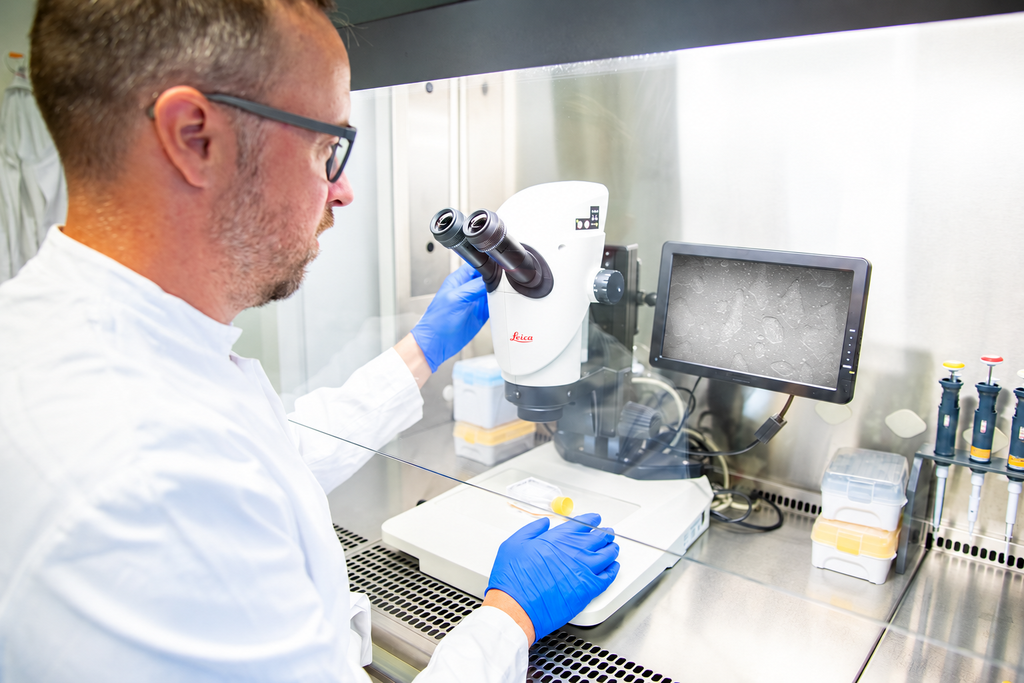
BREATH scientist Prof. Dr. Nico Lachmann examines macrophages under a microscope. (Photo: Karin Kaiser/MHH)