The CAPNETZ FOUNDATION is further advancing its research into community-acquired pneumonia (CAP). With CAPNETZ 3.0, a comprehensively revised study protocol scheduled for implementation at participating study centers in 2027, the foundation is creating new opportunities to investigate disease progression, risk factors, and the long-term consequences of pneumonia. CAPNETZ is an associated partner of the German Center for Lung Research (DZL) at the BREATH site in Hannover.
Despite significant advances in diagnosis, prevention, and treatment, community-acquired pneumonia remains a common infectious disease associated with a substantial burden of illness and mortality. By further developing its study protocol, the CAPNETZ FOUNDATION is expanding its established epidemiological observational study into a more comprehensive research platform that integrates clinical, microbiological, immunological, and data-driven research approaches.
Investigating Disease Progression in Greater Detail and Over Longer Periods
A key focus of the new study protocol is the enhanced clinical characterization of patients. In addition to more detailed information on disease severity, intensive care interventions, ventilation procedures, comorbidities, and forms of immunosuppression will be documented more systematically. This will help researchers identify risk factors for severe disease progression and complications with greater precision.
Another important development is the extension of follow-up assessments to up to 365 days after the acute infection. This will bring long-term health consequences into sharper focus, including persistent physical limitations, the worsening or new onset of comorbidities, and hospital readmissions.
In addition, patients’ own assessments will play a greater role. Patients will report how their symptoms, physical capacity, and quality of life develop over time following the infection. These so-called Patient-Reported Outcome Measures (PROMs) will complement clinical data by incorporating patients’ perspectives.
Pneumonia prevention will also receive greater attention. Vaccination status and history for pneumococcal disease, influenza, respiratory syncytial virus (RSV), COVID-19, and human metapneumovirus (hMPV) will be documented in greater detail. This will enable more precise investigations into the relationships between vaccination, infection risk, and pneumonia severity.
Expanded Biobank Opens Up New Research Opportunities
Another central component of the revised protocol is the expansion of the biospecimen collection. Additional blood samples, respiratory tract samples, and rectal swabs, together with repeated sample collection throughout the follow-up period, will enable more detailed analyses of immune responses, molecular disease mechanisms, and pathogen dynamics. These developments will also strengthen research into individual risk profiles and potential biomarkers associated with severe disease progression.
An important link to the DZL site BREATH is provided by the Hannover Unified Biobank (HUB) at Hannover Medical School (MHH), where biospecimens from the CAPNETZ study are stored long-term. The HUB is part of the DZL biobank infrastructure and ensures the quality-controlled storage of these valuable research samples.
The expanded biospecimen collection will therefore continue to provide an important foundation for scientific projects within the foundation’s research objectives and for collaborations across research sites.
New Approaches Through Imaging, Microbiome Research, and AI
The new study protocol will also enable CAPNETZ to explore additional research areas. These include establishing a centralized radiological imaging database, investigating potential links between the gut microbiome, immune responses, and pneumonia progression, and increasing the use of data-driven analytical methods.
By integrating clinical information with microbiological, immunological, and imaging data, researchers will gain new opportunities to investigate complex disease mechanisms using artificial intelligence (AI) and machine learning.
In the long term, these approaches aim to facilitate earlier identification of patients at increased risk and provide new foundations for more personalized prevention and treatment strategies. Through the comprehensive expansion of its study infrastructure, the CAPNETZ FOUNDATION is strengthening research into community-acquired pneumonia. As an associated partner of the DZL at the BREATH site, CAPNETZ also contributes to connecting clinical research with shared research infrastructures, creating new opportunities for collaborative projects across DZL sites in translational lung research.
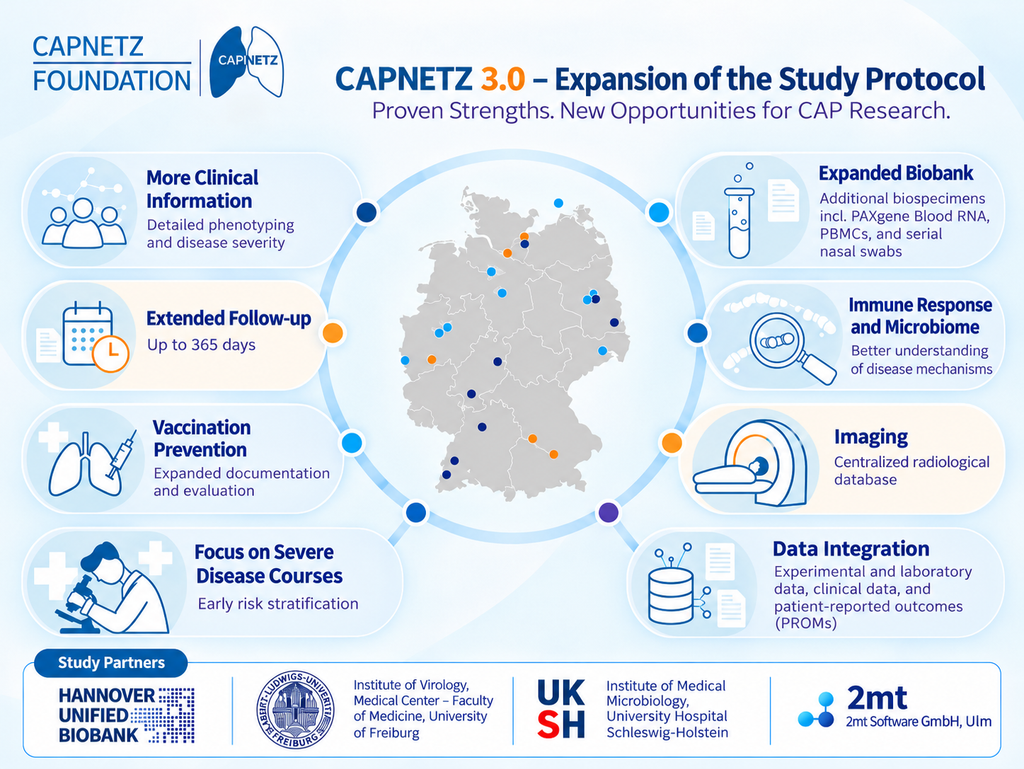
The CAPNETZ FOUNDATION is advancing its research into community-acquired pneumonia with the comprehensively revised CAPNETZ 3.0 study protocol.