For people with severe lung disease, lung transplantation is often the last treatment option. However, donor organs are scarce. Until a suitable organ becomes available, extracorporeal membrane oxygenation (ECMO) can support lung function. Yet the hollow-fiber membrane architecture used in current ECMO systems limits gas exchange, causes uneven blood flow and, together with the artificial surfaces, promotes blood clotting. A research team at Hannover Medical School (MHH), led by BREATH scientist Prof. Dr. Bettina Wiegmann, has now developed an entirely new, 3D-printable membrane architecture in cooperation with RWTH Aachen University. The new design not only improves oxygen transfer but also offers advantages in terms of blood compatibility.
For people with severe lung disease, transplantation of a healthy organ is often the only chance of survival. Yet donor lungs are in short supply. A new artificial lung could provide an alternative in the future. Since 2017, a team led by Prof. Dr. Bettina Wiegmann, emergency physician and specialist in cardiac surgery at the Department of Cardiothoracic, Transplantation and Vascular Surgery at Hannover Medical School (MHH), has been working on such a system within the German Research Foundation (DFG) Priority Programme “Towards an Implantable Lung”. Together with her research group at the Lower Saxony Centre for Biomedical Engineering, Implant Research and Development (NIFE), she is developing what is known as a biohybrid lung. The concept is based on extracorporeal membrane oxygenation (ECMO). In this clinically established lung support system, blood is passed along synthetic hollow-fiber membranes (HFMs), which carry out gas exchange.
The researcher has now taken an important step forward. Together with scientists at RWTH Aachen University, she has developed a novel membrane architecture that makes gas exchange substantially more efficient. The structure can be produced easily and precisely using 3D printing, achieves significantly higher oxygen transfer, and at the same time enables a more compact design. The approach is relevant not only for the development of implantable biohybrid lungs. In the future, it could also make conventional ECMO systems more powerful and compact. The study has been published in Advanced Materials, an internationally renowned journal in the field of materials science.
New Membrane Architecture
The HFMs currently used in ECMO resemble tiny drinking straws arranged closely and in parallel. However, this configuration generates flow disturbances. As a result, blood flow is not distributed optimally, limiting the efficiency of gas exchange. In addition, the interfaces between blood and the artificial surfaces increase the risk of thrombosis. “At present, ECMO can only bridge lung function for a limited period of time because blood forms clots when it comes into contact with artificial surfaces,” explains Professor Wiegmann.
She therefore relies on a different approach: an entirely new membrane architecture based on so-called triply periodic minimal surfaces (TPMS). Unlike densely packed HFMs, the TPMS structure forms a continuous three-dimensional network. This allows the blood to be distributed more evenly, enabling more efficient gas exchange while also providing the basis for more compact artificial lungs.
Up to 88 Percent More Oxygen Transfer
Similar to the alveoli of the natural lung, TPMS structures offer a very large surface area within a relatively small volume. This provides as much surface as possible for gas exchange in a very limited space. In the human lung, around 100 to 140 square metres of respiratory surface area are compactly distributed across approximately 300 million alveoli. Although TPMS structures do not yet achieve this packing density, they avoid regions of low blood flow and reduce flow resistance. They can also be manufactured easily and individually using modern 3D-printing techniques.
“We have optimised the TPMS architectures. This enables us to achieve up to 88 percent higher oxygen transfer than with conventional hollow-fiber membranes,” says Professor Wiegmann. “This means that in the future, the same or even better oxygenation could potentially be achieved with significantly smaller artificial lungs.”
Goal: CT Lung Images as a Template for 3D Printing
Not only the architecture but also the material used opens up new possibilities. The TPMS membranes are made of a special silicone polymer. It is biocompatible, non-toxic and chemically highly stable. At the same time, the material is highly permeable to oxygen and carbon dioxide, which is essential for efficient gas exchange. It can also be seeded with endothelial cells. These cells naturally line our blood vessels and are able to regulate blood clotting. This could significantly improve the blood compatibility of future artificial lungs.
The long-term goal of the research is to use computed tomography (CT) scans of a damaged lung to create a kind of “printing template” from which individually tailored artificial lung components or even entire lungs could be produced using 3D printing. Seeded with the patient’s own endothelial cells or genetically modified endothelial cells, these artificial lungs could then be implanted and permanently take over lung function.
“However, the new TPMS structure also has great potential even without endothelial cells,” emphasises Professor Wiegmann. “Simply replacing today’s hollow-fiber membranes with this architecture could make ECMO systems more efficient, more compact and more blood-compatible. In the longer term, it also provides the basis for implantable biohybrid lungs.”
Expertise Recognised in the United States
Professor Wiegmann now hopes that her research will continue to receive funding so that implantable biohybrid lungs can one day make their way into clinical practice—initially as a bridge to lung transplantation and, in the longer term, as a fully functional organ replacement.
The international recognition of her research and expertise is also reflected in a recent distinction from the United States. The American Society for Artificial Internal Organs (ASAIO) has named her to its “Inaugural Fellow Class 2026” in recognition of her research achievements, international engagement, and contributions to the advancement of biohybrid organ support systems and extracorporeal therapies. With this newly established and internationally prestigious distinction, the society honours leading scientists worldwide for their outstanding contributions to the development of artificial organs, advanced organ support systems and innovative translational therapeutic approaches.
Original publication: M. Pflaum, K. P. Barbian, F. Neuhaus, et al. “ From Fiber Bundles to Architected Membranes: Triply Periodic Minimal Surface Architectures for Biohybrid Artificial Lungs.” Advanced Materials (2026): e74361. https://doi.org/10.1002/adma.74361
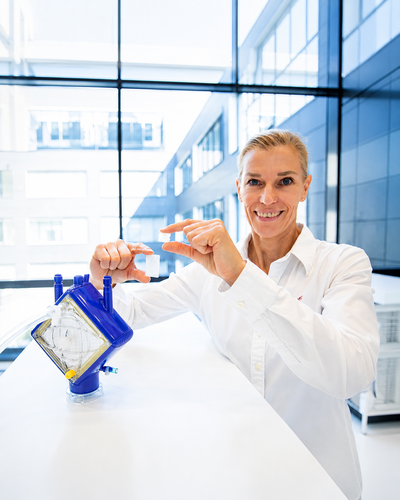
Smaller and more efficient: Prof. Dr. Bettina Wiegmann demonstrates the new TPMS membrane architecture (right) in comparison to the conventional hollow-fiber membrane bundles from an ECMO lung support system. Copyright: Karin Kaiser/MHH