Lung transplantation is often the final treatment option for people with severe lung disease. Despite advances in medicine, however, some patients develop chronic lung allograft dysfunction, or CLAD, which can ultimately lead to loss of function of the transplanted organ. Around half of all lung transplant recipients still die within six to ten years of the procedure.
The team led by BREATH researchers PD Dr Lavinia Neubert, pathologist and head of the Lung Research Group at the MHH Institute of Pathology, and PD Dr Jan-Christopher Kamp, pulmonologist at the MHH Department of Respiratory Medicine and Infectious Diseases, is focusing on so-called “super-survivors” – transplant recipients who show no signs of chronic rejection for at least three years.
The researchers are concentrating on alveolar macrophages, specialised immune cells located in the air sacs of the lungs. Previous studies suggest that these cells may play a protective and regulatory role after transplantation. The team now aims to determine which macrophage types and signalling pathways are associated with long-term graft tolerance and improved survival.
To this end, the researchers are analysing tissue and blood samples from super-survivors, patients with confirmed CLAD and healthy control participants. Using advanced proteomics methods and analyses of immune signalling molecules, they aim to identify new biomarkers that could in future be measured through simple, minimally invasive blood tests.
In the long term, the findings are intended to improve predictions of the clinical course after lung transplantation and support the development of new preventive treatment strategies. The goal is to promote protective mechanisms within the graft and to detect chronic rejection as early as possible, or even prevent it altogether.
The project, “Identifying liquid biomarkers for the prediction of clinical outcomes after lung transplantation using plasma proteomics”, is a collaboration involving several MHH institutions, the Hannover Unified Biobank (HUB) and the Fraunhofer Institute for Toxicology and Experimental Medicine (ITEM). The project began on 1 June 2026 and is scheduled to run for two and a half years.
Original source: Medizinische Hochschule Hannover : Biomarkers sought for improved transplant survival
Photo: Karin Kaiser/MHH
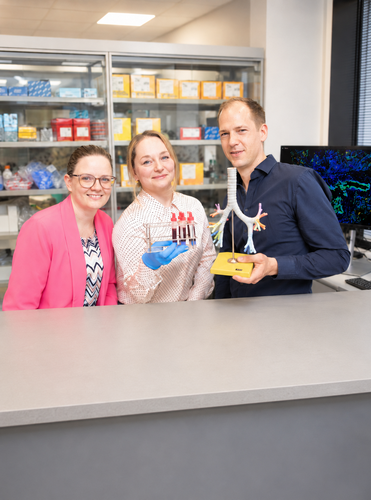
BREATH scientists PD Dr. Lavinia Neubert, Edith Schwarz and PD Dr. Jan-Christopher Kamp