In June 2025, Germany’s Federal Joint Committee (G-BA) paved the way for a nationwide lung cancer screening program. From April 2026 onwards, people with statutory health insurance who have smoked heavily over many years will be eligible to undergo LDCT as an early detection examination. The aim of this new benefit is to detect lung cancer much earlier and thereby significantly improve treatment outcomes. This decision represents a milestone in preventive medicine and is largely based on scientific evidence generated in Germany. The HANSE study was one of the key investigations that prompted the G-BA to establish lung cancer screening as a new reimbursed service. The newly published results build on this foundation and provide valuable guidance for the optimal design of the program.
More than 50,000 people are diagnosed with lung cancer each year in Germany. This disease—also referred to as bronchial or lung carcinoma—is the third most common cancer in women and the second most common in men. The main cause is smoking: the longer and more intensively a person has smoked, the higher their risk of developing lung cancer. Because the disease often causes symptoms only at a late stage, it is frequently diagnosed when it is already advanced, with correspondingly limited treatment options. By contrast, when lung cancer is detected early, surgical interventions as well as immunotherapy and chemotherapy offer significantly better chances of successful treatment.
Clinical studies examine the effectiveness of lung cancer screening
In recent years, international studies have shown that CT-based screening can help detect lung cancer at an earlier stage. A key question is which individuals benefit most from screening and how risk groups can be identified as precisely as possible. While people at high risk should clearly participate, unnecessary CT exposure should be avoided in those at low risk. Economic considerations also argue in favor of careful risk stratification.
This is where the HANSE study, initiated by the German Center for Lung Research (DZL), comes in. Researchers from LungenClinic Grosshansdorf, University Medical Center Schleswig-Holstein in Lübeck (both DZL site ARCN), Hannover Medical School (DZL site BREATH), and Charité Berlin (associated DZL partner), together with AstraZeneca, jointly evaluated the feasibility, acceptance, and effectiveness of a nationwide lung cancer screening program in Germany. The examinations were conducted by an interdisciplinary team of experienced physicians from the departments of pulmonology and radiology at the participating DZL sites. The results have now been published in The Lancet Oncology.
The team analyzed how reliably LDCT screening detects lung cancer when participant selection is based on a comprehensive risk model. The PLCOm2012 score was examined; in addition to age and smoking history, it includes factors such as educational level, body weight, the presence of chronic obstructive pulmonary disease (COPD), previous cancers, and a family history of lung cancer. For comparison, the so-called NELSON criteria were used, which form the basis of the planned German screening program and consider only age and tobacco exposure.
All individuals classified as high-risk according to either model underwent two LDCT examinations one year apart. Suspected cases were discussed in interdisciplinary boards and treated promptly once confirmed.
Expanded criteria identify almost 20 percent more cancer cases
The goal of the new early detection program is to reduce lung cancer mortality through earlier diagnoses. However, the results of the HANSE study show that the currently planned NELSON criteria may fail to capture important risk groups. “Our data show that using these criteria, we miss some people who also have a high risk of lung cancer and would benefit from the screening program,” says study lead Prof. Jens Vogel-Claussen. “If we take into account more factors than just age and smoking history, we detect almost 20 percent more lung cancer cases,” emphasizes the radiologist. Since October, he has been Director of the Department of Radiology at Charité. He originally initiated the HANSE study at Hannover Medical School (MHH) and continues to oversee it there as principal investigator.
The results are clear: in the PLCOm2012 group, 108 lung cancer cases were diagnosed among approximately 4,200 current or former smokers, compared with 85 cases in the similarly sized NELSON group. This corresponds to 19.4 percent more detected cancers, with only about 6 percent more individuals needing to be screened.
The data also show that women in particular would benefit from the expanded approach. In the HANSE study, 2.6 percent of women were diagnosed with lung cancer—significantly more than the 1.8 percent observed in men. However, under the NELSON criteria currently planned for screening inclusion, many women do not meet the eligibility requirements. “Many of the women in our study actively smoke, but over their lifetime have smoked fewer cigarettes than men and therefore do not reach the current inclusion threshold applied in Germany,” explains Dr. Sabine Bohnet, Head of the Lung Cancer Center at the UKSH Campus Lübeck and co-author of the study. “In addition, they more frequently have a family history of lung cancer, a personal history of cancer, or an additional diagnosis of COPD. We assume that these risk factors carry greater weight in women than in men. Unfortunately, they are not captured by the currently applied criteria.”
The researchers emphasize, however, that the introduction of LDCT screening is in any case a major advance in lung cancer prevention. Thanks to the new data, important impulses are now available for further development of the program. The HANSE study not only underscores the high feasibility of screening in routine care, but also provides key scientific arguments for making the program more precise, gender-sensitive, and efficient in the future.
About the HANSE study
The HANSE study is an investigator-initiated trial. It compared the NELSON inclusion criteria with selection based on the PLCOm2012 score, corresponding to a six-year lung cancer risk of at least 1.58 percent. Participants were recruited at Hannover Medical School (MHH), University Medical Center Schleswig-Holstein at the Lübeck campus, and LungenClinic Grosshansdorf. All three sites are lung cancer centers certified by the German Cancer Society (DKG). The study was funded by the DZL and, within the Lung Ambition Alliance, by AstraZeneca.
The HANSE study is ongoing: between autumn 2025 and summer 2026, participants already enrolled who are at high risk of lung cancer will receive an additional CT screening. In addition, the study will, for the first time, investigate whether blood-based biomarkers can be identified that may enable even earlier diagnosis of lung cancer in the future. The aim is to further improve the precision and effectiveness of screening.
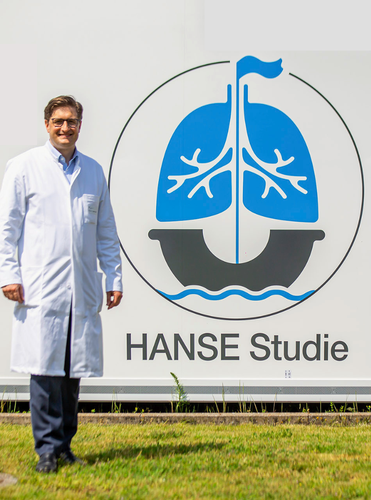
BREATH scientist and study lead of the HANSE study Prof. Dr. Jens Vogel-Claussen