Julia Rückoldt is a doctoral researcher and scientist at the DZL site BREATH. In the Lung Research working group led by PD Dr. Lavinia Neubert and PD Dr. Jan-Christopher Kamp, she and her colleagues use organoids to investigate how lung epithelial cells change in pulmonary diseases.
For her experiments, she uses organoids derived from primary human alveolar type 2 epithelial cells, or AT2 cells. These cells perform important functions in the alveoli and contribute to the regeneration of the alveolar epithelium. Her research focuses on mesenchymal transition, a process in which epithelial cells increasingly acquire characteristics of connective tissue cells. This process may play a role in various lung diseases.
Considerable Differences Between Organoids
AT2 cells are rare in human lung tissue and are biologically highly heterogeneous. Consequently, the organoids derived from them also vary considerably in shape and structure. Comprehensive characterization of the organoids is therefore essential for interpreting stimulation experiments.
For this purpose, Julia Rückoldt collaborates with Noah Heldt. The doctoral researcher at the DZL site ARCN is a member of the DZL Imaging Platform and contributes his expertise in dynamic optical coherence tomography, or DOCT.
DOCT is a high-resolution, label-free imaging technique. It enables three-dimensional visualization of biological samples without the need for dyes or fluorescent markers. In addition, only small amounts of sample material are required – an important advantage when working with rare primary cells.
A Collaborative Project Across DZL Sites
Their collaboration led to the JUNO project, “Joint Utilization of Novel Imaging Technology for AT2 Organoids”, which aims to investigate whether DOCT is suitable for the detailed and repeated analysis of AT2 cell organoids. At the beginning of the year, Julia Rückoldt and Noah Heldt carried out their first joint experiments. They successfully visualized the complex three-dimensional cellular organization of the organoids and demonstrated the general suitability of the technology for this application.
The next step will involve longitudinal measurements during various stimulation experiments. The same organoids will be examined repeatedly over an extended period of time. In this way, the researchers aim to track how organoid structure changes over the course of mesenchymal transition.
Julia Rückoldt and Noah Heldt are members of the first cohort of the DZL DataLung School. It was through this program that the two researchers met and jointly developed the idea for the JUNO project. Julia Rückoldt and Noah Heldt presented their initial results at the DZL Annual Meeting in Wiesbaden, where their work received the poster award from the “Platform Imaging”.
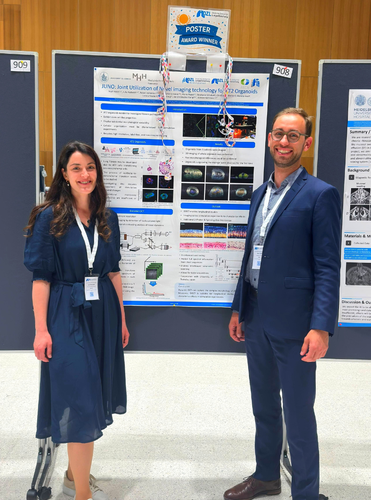
Poster award winners at this year’s DZL Annual Meeting in the “Platform Imaging” category: BREATH early-career researcher Julia Rückoldt and her project partner Noah Heldt from the DZL site ARCN. Photo: private