Poster Award for Maeva Katzmarzyk: How the Lung’s Immune Experience Can Protect Against New Infections
Can the lung’s “immune experience” protect against subsequent infections?
The study focuses on cytomegalovirus (CMV), a widespread herpesvirus that remains in the body for life after infection. Latent CMV infection causes long-term changes in the immune system and, among other effects, promotes the maintenance of certain memory T cells. The research team investigated whether this immunological imprint influences how the lung responds to a subsequent infection with a different virus.
Using a mouse model, the researchers found that animals with latent MCMV infection (murine cytomegalovirus) developed less severe disease following subsequent SARS-CoV-2 infection and had significantly lower viral loads in the lungs than animals without prior MCMV infection. Importantly, the route of the initial MCMV infection proved decisive: only infection via the respiratory tract resulted in the formation of large numbers of tissue-resident CD8⁺ memory T cells, known as tissue-resident memory cells (TRM), in the lungs—and only under these conditions was a protective effect against SARS-CoV-2 observed.
Tissue-resident memory T cells as the key
The protected animals also showed less lung tissue damage and lower concentrations of pro-inflammatory signaling molecules. Remarkably, the protective effect persisted over a long period of time, including in older animals and up to one year after the initial MCMV infection.
Further experiments confirmed the central role of TRM cells: when these cell populations could not be maintained during latent CMV infection, the protection against SARS-CoV-2 was also lost. At the same time, specifically boosting SARS-CoV-2-specific T-cell responses provided no additional benefit. This suggests that the long-term CMV-induced changes in the local immune environment of the lung are particularly important.
The findings therefore demonstrate that the immunological history of the lung can influence how it responds to subsequent infections. Previous immune experiences could thus be an important factor in shaping local protection against new pathogens. “As a next step, we would like to better understand the mechanisms underlying this protection and determine whether these findings could eventually lead to new approaches for specifically strengthening local immune defenses in the lung,” says Maeva Katzmarzyk.
We warmly congratulate Maeva Katzmarzyk and the entire research team on receiving the poster award and wish them every success in their future work.
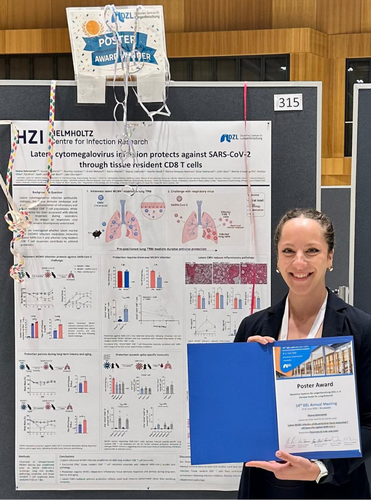
BREATH doctoral researcher Maeva Katzmarzyk proudly stands in front of her award-winning poster (Photo: private)